


Page 106 - All Signs Safety Signs
P. 106
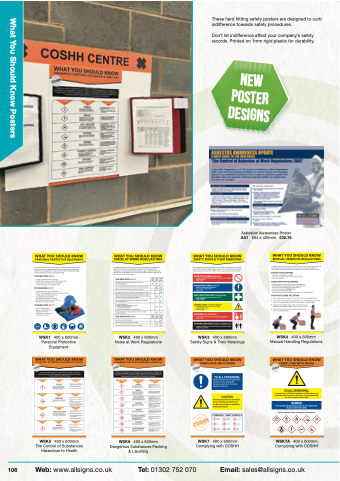
    WSK1 400 x 600mm Personal Protective Equipment
WSK2 400 x 600mm Noise at Work Regulations
WSK3
WSK4 400 x 600mm Manual Handling Regulations
WSK5 400 x 600mm The Control of Substances Hazardous to Health
WSK6 400 x 600mm Dangerous Substances Packing & Labelling
WSK7 400 x 600mm Complying with COSHH
WSK7A 400 x 600mm Complying with COSHH
Incurable damage to hearing can be caused by exposure to high noise levels. The noise at work regulations calls for both employers and employees to reduce the risk of hearing damage to a practical and safe level within the workplace ensure you are familiar with the categories of risk and the action to be taken.
THE EMPLOYER MUST:
Reduce the risks of hearing damage to the lowest levels
reasonably practicable
So far as reasonably practicable place notices and warning signs in ear protection zones.
Ensure ear protection is used by all those who enter marked ear protection zones.
THE EMPLOYEE MUST: Use the ear protectors provided.
Use all other protective equipment provided.
Report any faults or defects found with the equipment.
NOISE LEVEL BELOW 80db(A)
NOISE LEVEL BELOW 80db(A)
FIRST ACTION LEVEL 80db(A)
FIRST ACTION LEVEL 80db(A)
SECOND ACTION LEVEL 85db(A)
SECOND ACTION LEVEL 85db(A)
106 Web: www.allsigns.co.uk Tel: 01302 752 070 Email: [email protected]
These hard hitting safety posters are designed to curb indifference towards safety procedures.
Don’t let indifference affect your company’s safety records. Printed on 1mm rigid plastic for durability.
400 x 600mm Safety Signs & Their Meanings
Asbestos Awareness Poster
AA1
594 x 420mm
£30.76
 NEW
POSTER DESIGNS
 What You Should Know Posters
   WHAT YOU SHOULD KNOW MANUAL HANDLING REGULATIONS
 In situations where risks cannot be controlled by other means such as systems of work or engineering controls, employers are required to project their employees from
risks to health and safety by providing suitable personal protective equipment (PPE).
ASSESS THE SITUATION:
• Can manual handling be avoided?
If so use a mechanical aid to lift or move the load.
• If not plan your lift.
CHECK FOR THE FOLLOWING:
• Potential hazards i.e. packing hooks, sharp edges etc.
• Check stability of parcel, ease of grip, weight of parcel.
• Know your route, avoiding slip or trip hazards.
• Know your destination BEFORE lifting.
• Can you stop and rest if needed.
• Are you wearing protective equipment i.e. gloves and safety boots.
YOUR SAFE GUIDE TO LIFTING:
1. Keep a wide base of support. Your feet should be shoulder-width apart.
2. Squat down, bending at the hips and knees only. If needed, put one knee to
the floor and your other knee in front of you (bent at a right angle).
4. Slowly lift by straightening your hips and knees (not your back). Keep your back straight and don't twist as you lift.
5. Hold the load as close to your body as possible, at the level of your belly button.
     WHAT YOU SHOULD KNOW PERSONAL PROTECTIVE EQUIPMENT
 In situations where risks cannot be controlled by other means such as systems of work or engineering controls, employers are required to protect their employees from risks to health and safety by providing suitable personal protective equipment (PPE).
THE EMPLOYER MUST:
• Provide suitable PPE free of charge.
• Maintain PPE in good working order and condition.
• Provide relevant training in the use of PPE.
• Consult employees on suitability of PPE.
PPE PROVIDER MUST:
• Be relevant for the work undertaken.
• Protect effectively against the particular risks involved.
• Comply with community directives.
• Fit properly and comfortably
(adjusting in size where necessary).
• Not hinder the performance of any task.
• Not add to the risks involved.
THE EMPLOYEE MUST:
• Use the PPE provided.
• Report any loss, defects or
damage to the PPE.
• Take care to correctly store
PPE when not in use.
     WHAT YOU SHOULD KNOW NOISE AT WORK REGULATIONS
  Ensure noise assessments are carried out by a competent person. Ensure a record of assessment is kept until re-assessed.
Use means other than ear protectors to reduce exposure to noise.
Provide necessary training, instruction and information on risks to hearing and how to minimise them and how to obtain ear protectors when noise level between 80db (A) and 85db (A).
 Ensure ear protection is:
1. Provided to employees who ask for them
2. Provided to all those exposed
3. Are used by those exposed
4. Are kept and maintained to a satisfactory level
  WHAT YOU SHOULD KNOW SAFETY SIGNS & THEIR MEANINGS
 Recent regulation changes place a responsibility on employers to provide and maintain sufficient safety signs to warn of circumstance where risks to health & safety exists and to advise of precautions that need to be taken.
      PROHIBITION SIGNS (DO NOT DO)
• A sign prohibiting behaviour likely to increase or cause danger
e.g. No Smoking
• Colour - Red
MANDATORY SIGNS (MUST DO)
• A sign prescribing specific behaviour
e.g. Hard hats must be worn
• Colour - Blue
SAFE CONDITION SIGNS (THE SAFE WAY)
• A sign indicating emergency exits or first aid /
rescue equipment
• Colour - Green
HAZARD SIGNS (CAUTION, BEWARE)
• A sign giving warning of a hazard or danger
e.g. Danger Electricity
• Colour - Yellow
FIRE SIGNS (FIRE EQUIPMENT)
• A sign indicating the location of fire fighting equipment
• Colour - Red
INFORMATION SIGNS (GENERAL INFORMATION)
• A sign providing general information not covered by the above categories e.g. Toilets.
          WHAT YOU SHOULD KNOW THE CONTROL OF SUBSTANCES HAZARDOUS TO HEALTH
  Under the COSHH regulations, all persons should know the relevant safety precautions to take, if exposed to substances hazardous to health. It is your duty to know the following
THE SYMBOL THE MEANING PRESCAFUETIYONS
 THE SYMBOL THE MEANING PRESCAFUETIYONS
 THE SYMBOL THE MEANING PRESCAFUETIYONS
  THE SYMBOL THE MEANING PRESCAFUETIYONS
    WHAT YOU SHOULD KNOW DANGEROUS SUBSTANCE PACKAGING & LABELLING
   Under the chemical regulations, any dangerous chemicals supplied in a package must be labelled and packaged in a manner suitable to withstand the conditions of supply and transportation. The act is designed to safeguard both people and the environment from hazardous effects of chemicals. Ensure you know the following:-
THE SYMBOL CTHLAESMSIEFAICNAINTIGON& PRTHECEASUATFIEOTNYS
             WHAT YOU SHOULD KNOW COMPLYING WITH COSHH
          WHAT YOU SHOULD KNOW
COMPLYING WITH COSHH (CONTROL OF SUBSTANCES HAZARDOUS TO HEALTH)
    TO ALL PERSONNEL
To comply with COSHH Regulations of 2002 please pay particular attention to any container or product bearing any of the symbols illustrated
  ALWAYS
Follow departmental instructions for the protection of your health and safety
Hazard symbols most commonly encountered


